Monday, July 5, 2010

Wingless Insects

Flight among insects are varied. Some fly, some do not and some have forgotten it. There are numerous different groups of insects who have lost their wings or greatly reduced them. Unlike primitively wingless insects such as silverfish, fleas and lice have lost the wings their ancestors once had.


From left to right: silverfish, flea and lice

Female gypsy moths have underdeveloped wing muscles and don't fly. They don't need to, for the males fly to them, attracted by a chemical lure which they can detect at astounding dilutions. If the females were to move as well as the males, the system probably wouldn't work, for by the time the male had flown up the slowly drifting chemical gradient, its source would have moved on.

The female of the dreaded gypsy moth

Unlike most insects, which have four wings, the flies, as their latin name Diptera suggests, have only two. The second pair of wings has become reduced to halteres.

Diptera

The second pair of wings have become reduced to a pair of halteres. These swing about like very high speed Indian clubs, which they resemble, functioning as tiny gyroscopes. We know these halteres are vestigial remains of wings for several reasons
- they occupy exactly the same place in the third segment of the thorax as the flying wing occupies in the second thoracic segment (and the third too in other insects).
- they move in a figure of eight pattern as the wings of flies.
- they have the same embryology as wings and, although they are tiny, if you look at them carefully, especially during development, you can see that they are stunted wings, clearly modified.
- all insect wings have tiny sense organs in the base, which detect twisting and other forces. The sense organs at the base of halteres are very similar.

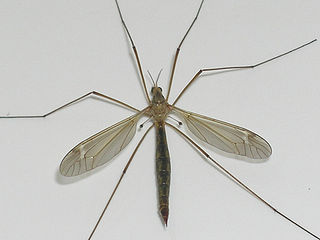
Halteres on a cranefly

Halteres are what makes between stable and unstable fliers. In any flying machine, there is a trade-off between stability and maneuverability. John Maynard Smith pointed out that animals lose inherent stability in the interests of increased maneuverability, but paying for it in the form of increased instrumentation and computation capability - brain power. The four winged ancestors of flies probably had long abdomens which would make them stable. All four wings would have acted as rudimentary gyroscopes. The ancestors of flies started to move along the stability continuum becoming more maneuverable and less stable as the abdomen got shorter. The hind wings started to shift more towards the gyroscopic function (which they had always performed, in a small way, as wings), becoming smaller, and heavier for their size, while the forewings enlarged to take over more of the flying. There would have been a gradual continuum of change, as the forewings assumed ever more of the burden of aviation, while the hind wings shrank to take over the avionics.

Worker ants have lost their wings, but not the capacity to grow wings. They lost their wings in evolution because they are a nuisance and get in the way underground. Queen ants and male ants have wings and worker ants are females who could have become queens but for environmental reasons (not genetic) failed to become queens. Queen ants use their wings only once, to fly out of the natal nest, find a mate and then settle down to dig a hole for a new nest. As they begin their new life underground the first thing they do is lose their wings, in some cases by literally biting them off.


An additional reason for winglessness is an evolutionary defense mechanism of assuming a protective resemblance to ants, either (or both) to fool the ants or to fool would-be predators who might otherwise pick them out from among the less palatable and better protected ants.

Sunday, July 4, 2010

Wingless Birds

Not all birds fly. Ostriches and Emus are fast runners that never fly. But all birds carry at least relics of the apparatus of flight.

Ostrich Wing Stubs are only used for balancing and steering while running and when they enter into social and sexual displays.

Kiwi wings are too small to be seen outside the birds fine coat of feathers, but vestiges of wing bones are there.

Moas (which got extinct 1500AD)

Moas have lost their wings entirely. Their home country of New Zealand has more than its fair share of flightless birds, probably because the absence of mammals left wide open niches to be filled by any creature that could get there by flying. But those flying pioneers, having arrived on wings, later lost them as they filled the vacant mammal roles on the ground. This probably doesnt apply to the moas themselves, whose ancestors, as it happened, were already flightless before the great southern continent of Gondwana broke up into fragments, New Zealand among them, each bearing its own cargo of Gondwanan animals. But it sure does apply to kakapos, New Zealand's flightless parrots, whose flying ancestors lived so recently that kakapos still try to fly although they lack the equipment to succeed.

Kakapos, the heavyweight champion of all parrots

Penguins and Galapagos Cormorants are another two birds who use their wings for other purposes than flight. Ostriches, emus and rheas are great runners, but penguins and Galapagos flightless cormorants are great swimmers. But unlike penguins, who use their short wings to fly underwater, Galapagos cormorants propel themselves with their powerful legs and huge webbed feet, using their wings only as stablizers.

Galapagos Cormorants

But all flightless birds, including ostriches and their kind, which lost their wings a very long time ago, are clearly descended from ancestors that used them to fly.

Saturday, July 3, 2010

Whales

Whales and Dolphins (which are actually smaller whales) evolved from land creatures. You don't have to dig very deep inside a dolphin to uncover its history of life on dry land. Despite its streamlined, fish-like exterior, and despite the fact that it now makes its entire living in the sea and would soon die if beached, a dolphin has land mammal written all over it.

blowhole of a dolphin

Firstly, it has lungs not gills, and will drown like any land animal if prevented from coming up for air, although it can hold its breath for much longer than a land mammal. Instead of breathing through two little nostrils at the end of its nose, it has a single nostril in the top of its head, which enables it to breathe while only just breaking the surface (see blowhole in the picture). This blowhole has a tight sealing valve to keep water out, and a wide bore to minimize the time needed for breathing.

The dolphins blowhole goes to great lengths to correct a problem that would never have arisen at all if only it breathed with gills, like a fish. And many of the details of the blowhole can be seen as corrections to secondary problems that arose when the air intake migrated from the nostrils to the top of the head.

Another indication of its land origins is that although whales have no hind legs, there are tiny bones, buried deep inside them, which are the remnants of the pelvic girdle and hind legs of their long-gone walking ancestors. The same is true of the sirenians or sea cows.


The skeleton of a whale. Notice (c) the hind legs that have no utility otherwise

Sirenians are very different from whales and dolphins but they are the only other group of wholly marine mammals that never come ashore. Where dolphins are fast, actively intelligent carnivores, manatees and dungogs are slow, dreamy herbivores. Manatees and Dungongs achieve hydrostatic equilibrium without the swim bladder that fishes have but with the use of heavy bones as a counterweight to the natural buyoancy of their blubber. Their specific gravity is therefore very close to that of water and they can make fine adjustments to it by pulling in or expanding the rib cage. The precision of their buoyancy control is enhanced by the possession of a seperate cavity for each lung: they have two independant diaphragms.

Dolphins and whales, dungongs and manatees give birth to live babies, like all mammals. That habit is not actually peculiar to mammals. Many fish are livebearers, but they do in a very different way. The dolpins placenta is unmistakably mammalian, and so is its habit of suckling the young with milk. Its brain, is also beyond question the brain of a mammal, and a very advanced mammal at that. The cerebral cortex of a mammal is a sheet of grey matter, wrapped around the outside of the brain. Getting brainier partly consists in increasing the area of the sheet. This could be done by increasing the total size of the brain, and of the skull that houses it. But there are downsides to having a big skull. It makes it harder to be born, for one thing. As a result, brainy mammals contrive to increase the area of the sheet while staying within limits set by the skull, and they do it by throwing the whole sheet into deep folds and fissures. This is why the human brain looks like a wrinkled walnut; and the brains of dolpins and whales are the only ones to rival those of us apes for wrinkliness.

whale brain

human brain


fish brain

Fish brains don't have wrinkles at all. Indeed, they don't have a cerebral cortex, and the whole brain is tiny compared to a dolpins or humans. This is another of dolphins mammalian history, along with the placenta, milk, a four-chambered heart, a lower jaw having only a single bone, warm-bloodedness and many other specifically mammalian features.

Thursday, July 1, 2010

Fish

When we say fish, we generally imply anything that lives in water. But the dictionary defines fish as - any of various cold-blooded aquatic vertebrates having gills, commonly fins and typically an elongated body covered with scales. Now this definition excludes a lot of sea animals.

Dungongs

whales

Whales and dungongs come from a lineage of land animals. So there were some creatures that emerged from the sea to land, which was a major evolutionary step, and some who went back to the sea after their shortlived land habitation. Seals and Sea lions have only gone part-way back. But whales (including the small whales we call dolphins) and dungongs with their close cousins the manatees, ceased to be land creatures altogether and reverted to the full marine habits of their remote ancestors. But they do, however, still breathe air, having never developed anything equivalent to the gills of their earlier marine progenitors. Other animals that have returned from land to water, at least some of the time, are pond snails, water spiders, water beetles, crocodiles, otters, sea snakes, water shrews, Galapagos flightless cormorants, Galapagos marine iguanas, yapoks, platypuses, penguins and turtles.

Instead of spinning regular silk webs, they form platicy, silky air bubbles on the surface of water

Wednesday, June 30, 2010

Goosebumps

Each time I hear the rendition of Bumbleboogie, I get goosebumps.

Lets freeze that scene... Me hearing Bumbleboogie and goosebumps all over my forearm. Why do I get goosebumps? We have to search a distant past to answer that question. Because goosebumps are the vestiges of our ancient ancestors. Use the remote to reverse back a couple of scores of years. And you see, my ancient hirsute ancestors, normal mammals with hairs all over. Their hairs were raised or lowered at the behest of sensitive bodily thermostats. Too cold and the hairs were erected, thus trapping a layer of air which served as insulation from the cold. The thicker the hair layer, the more heat it retains. Warm, and the coat was flattened to allow body heat to escape more easily. Forward back to the scene where I am listening to Bumbleboogie.

There I sit, having goosebumps on my forearm. But wait, I am not cold over there. Why am I still getting goosebumps? Well, if you take a live snake to a zoo and show it to a chimp, you gonna see its hair raising up. A sudden jhatka to a cat, and its fur turns up. The reason, they say, is that when hairs stand on end, it tends to increase the body's apparent size and scare off dangerous rivals or predators. Switch back to me listening to bumblebee boogie.

But wait, what has listening to Bumbleboogie got anything to do with a sensitive bodily thermostat or fear or anger? Well, you get goosebumps not only when you are cold but when you walk the aisle to get betrothed to your loved one or when the national anthem is put on after a stunning victory by your country or when you walk through the blackness of the night and there are creepy sounds all around you. Whats common in all the above scenarios? They are all emotionally packed.

The reason for all these responses is the subconscious release of a stress hormone called adrenaline. Adrenaline, which in humans is produced in two small beanlike glands that sit atop the kidneys, not only causes the contraction of skin muscles but also influences many other body reactions. In animals, this hormone is released when the animal is cold or facing a stressful situation, preparing the animal for flight-or-fight reaction. In humans, adrenaline is often released when we feel cold or afraid, but also if we are under stress and feel strong emotions, such as anger or excitement. Other signs of adrenaline release include tears, sweaty palms, trembling hands, an increase in blood pressure, a racing heart or the feeling of 'butterflies' in the stomach.

The hair-erection machinery is a vestige, a non-functional relic of something that did a useful job in our long-dead ancestors. Vestigial hairs are among the many instances of history written all over us.

Sunday, June 27, 2010

Birds

There are some sunning films available on YouTube of balletic maneuvers of the flocking behavior of starlings. These were taken by Dylan Winter over Otmoor near Oxford. What is remarkable about the starlings behavior is that, despite all appearances, there is no choreographer and as far as we know, no leader. Each individual bird is just following local rules.

THE BOIDS

- the story of regularity in chaos in nature

The numbers of individual birds in these flocks can run into thousands, yet they almost literally never collide. Which is just as well for, given the speed at which they fly, any such impact would severely injure them. Often the whole flock seems to behave as a single individual, wheeling and turning as one.

The whole performance would make a more than usually elegant screensaver on a computer. And this is neatly possible in an almost analogical way to how embryology works. Here's how to program flocking behavior in starlings. Devote almost all your effort to programming the behavior of a single individual bird. Build into your robo-starling detailed rules for how to fly, and how to react to the presence of the neighbouring starlings depending on their distance and relative position. Build in rules for how much weight to give individual initiative in changing direction. These model rules would be informed by careful measurements of real birds in action. Endow your cyberbird with a certain tendency to vary its rules at random. Having written a complicated program to specify the behavioural rules of a single starling, now clone the single bird to make a thousand copied, all same as each other (or maybe with some slight random variation among them in their rules) and release them to freely interact with each other.

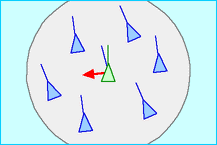
Craig Reynolds called it boids and wrote a program along these lines in 1986. The basic flocking model in his program consisted of 3 elements:
1. Separation (steer to avoid crowding local flockmates)

2. Alignment (steer to the average heading of local flockmates)

3. Cohesion (steer to move towards the average position of local flockmates)

Each boid has direct access to the whole scene's geometric description, but flocking requires that it only interacts with flockmates within a certain small neighbourhood around itself. The neighbourhood is characterized by distance (measured from center of the boid) and an angled (measured from the direction of boid's flight). Flockmates outside this neighbourhood are ignored.
The key point is that there is no choreographer and no leader. Order, organization, structure - these all emerge as by-products of rules which are obeyed locally and many times over, not globally. And that is how embryology works. It is all done by local rules, at various levels but especially the level of the single cell. In the field of development, or manufacture, the equivalent of this kind of programming is self-assembly.


Monday, June 21, 2010

Dogs

The origin of Dogs is regarded a controversial subject. Where did they come from? Overwhelming evidence from behavior, vocalizations, morphology, and molecular biology led to the contemporary scientific understanding that a single species, the gray wolf, is the common ancestor for all breeds of domestic dogs. However, the time-frame and mechanisms by which the divergence actually happened is controversial.

Raymond Coppinger points out that when domestic animals break free and go feral for many generations, they usually revert to something close to their wild ancestor. We might expect feral dogs, therefore to become rather wolf-like. But this doesn't happen. Instead, dogs left to go feral (wild) seem to become the ubiquitous 'village dogs' - 'pyre dogs' - that hang around human settlements all over the third world. Coppinger believes that the dogs on which which human breeders finally went to work were wolves no longer. They had already changed themselves into dogs: village dogs, pye-dogs, perhaps dingos.

The current consensus among biologists and archaeologists is that the dating of first domestication is indeterminate. There is conclusive evidence that dogs genetically diverged from their wolf ancestors at least 15,000 years ago, but some believe domestication to have occurred earlier. It is not known whether humans domesticated the wolf as such to initiate dog's divergence from its ancestors, or whether dog's evolutionary path had already taken a different course prior to domestication. Here is the story of an experiment that happened in Novosibirsk, Siberia that tries to prove the latter.

THE SILVER FOX EXPERIMENT
- a real life study in domestication

The silver fox is a melanistic colour variant of the familiar red fox, Vulpes vulpes. The Russian geneticist Dimitri Belyaev was employed to run a fox fur farm in the 1950s.

Domesticated Silver Fox

Wild foxes are tricky to handle, and Belyaev set out deliberately to breed for tameness. Like any other animal or plant breeder of his time, his method was to exploit natural variation (no genetic engineering in those days) and choose, for breeding, those males and females that came closest to the ideal he was seeking. In selecting for tameness, Belyaev could have chosen, for breeding, those dogs and bitches that most appealed to him, or looked at him with the cutest facial expressions. That might well have had the desired effect on the tameness of future generations. More systematically than that, however, he used a measure that was pretty close to the flight distance.

One of the main difference between wolf and dog behaviour is the flight distance. Real wolves are pack hunters. Village dogs are scavengers that frequent middens and rubbish dumps. Wolves scavenge too, but they are not temeperamentally suited to scavenging human rubbish because of their long flight distance. If you see an animal feeding, you can measure its flight distance by seeing how close it will let you approach before fleeing. For any given species in any given situation, there will be an optimal flight distance, somewhere between too risky or foolhardy and too flighty or risk averse. Individuals that take off too late when danger threatens are more likely to be killed by that danger. Individuals that are too flighty never get a square meal, because they run away at the first hint of danger on the horizon.

Belyaev and his colleagues (and successors, for the experimental program continued after his death) subjected fox cubs to standardized tests in which an experimenter would offer a cub food by hand, while trying to stroke or fondle it. The cubs were classified into three classes. Class III cubs were those that fled from or bit the person. Class II cubs would allow themselves to be handled, but showed no positive responsiveness to the experimenters. Class I cubs, the tamest of all, positively approached the handlers, wagging their tails and whining. When the cubs grew up, the experimenters systematically bred only from this tamest class.

After a mere six generations of this selective breeding for tameness, the foxes had changed so much that the experimenters felt obliged to name a new category, the domesticated elite class, which were eager to establish human contact, whimpering to attract attention and sniffing and licking experimenters like dogs. At the beginning of the experiment, none of the foxes were in the elite class. After 10 generations of breeding for tameness, 18 percent were elite. After 20 generations, 35 percent and after 30-35 generations, domesticated elite individuals constituted between 70 - 80 percent of the experimental population.

Such results are perhaps not too surprising, except for the astonishing magnitude and speed of the effect. 35 generations would pass unnoticed on the geological timescale. Even more interesting, however, were the unexpected side-effects of the selective breeding for tameness. The tame foxes not only behaved like domestic dogs, they looked like them. They lost their foxy pelage and became piebald black and white, like Welsh collies. Their foxy prick ears were replaced by doggy down like a fox's brush. The females came on heat every six months like a bitch, instead of every year like a vixen. According to Belyaev, they even sounded like dogs.

In fact, when USSR collapsed the fur farm was forced to find funds by selling 600 of their 700 silver foxes as pets. At last report, "Most of the project expenses are covered by selling the foxes as pets, but the project remains in a difficult situation, looking for new sources of revenue from outside funding."

These dog-like features were side-effects. Belyaev and his team did not deliberately breed for them, only for tameness. Those other dog-like characteristics seemingly rode on the evolutionary coat-tails of the genes for tameness. To geneticists, this is not surprising. They recognize a widespread phenomenon called pleiotropy. Presumably genes for floppy ears and piebald coats are pleiotropically linked to genes for tameness, in foxes as well as in dogs. This illustrates a generally important point of evolution. When you notice a characterstic of an animal and ask what its Darwinian survival value is, you maybe asking the wrong question. It could be that the characteristic you have picked out is not the one that matters. It may have come along for the ride dragged along in evolution by some other characteristic to which it is pleiotropically linked.

The evolution of the dog then, if Coppinger is right, was not just a matter of artificial selection, but a complicated mixture of natural selection (which predominated in the early stages of domestication) and artificial selection (which came to the fore more recently).

In answer to the more controversial question, when did wolves suddenly evolve to dogs, this laboratory experiment gives a lower bound on how long it took. The true answer is somewhat still argued upon.

A couple of other findings with the Silver Fox experiments: The experimenters also breeded the most aggressive of silver foxes for comparison with domestic ones trying to find which genes controlled the aggressive behavior. The answer is not one particular set of genes but a lot of changes that controls the behavior. To the nurture v/s nature argument, they tried interchanging cubs of the tamer species with the aggressive ones and vice versa. But it doesnt matter what genes your surrogate mother has. The essential gene that controlled the aggressiveness and tameness still controlled the nature of the cub.